


Why has dressing up a facade become a strategic act for brands?
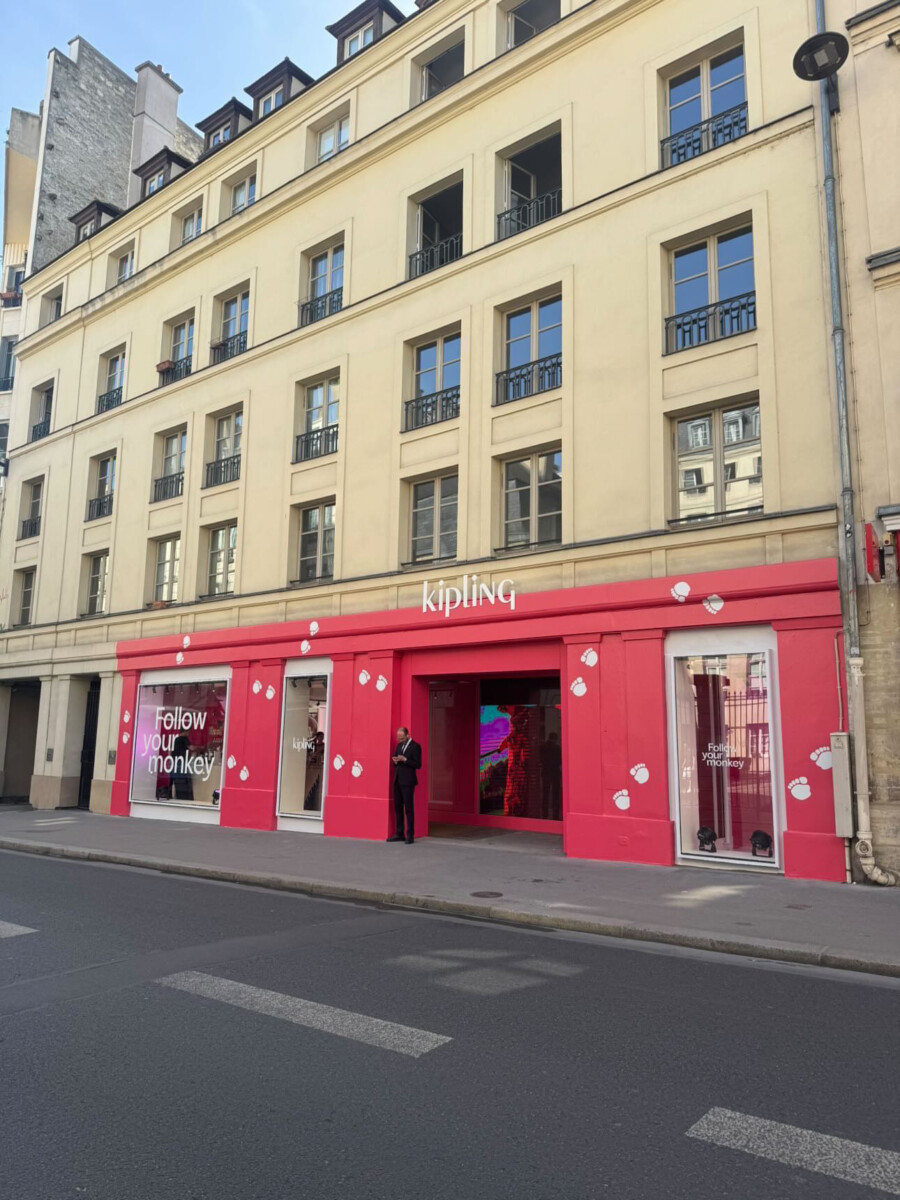
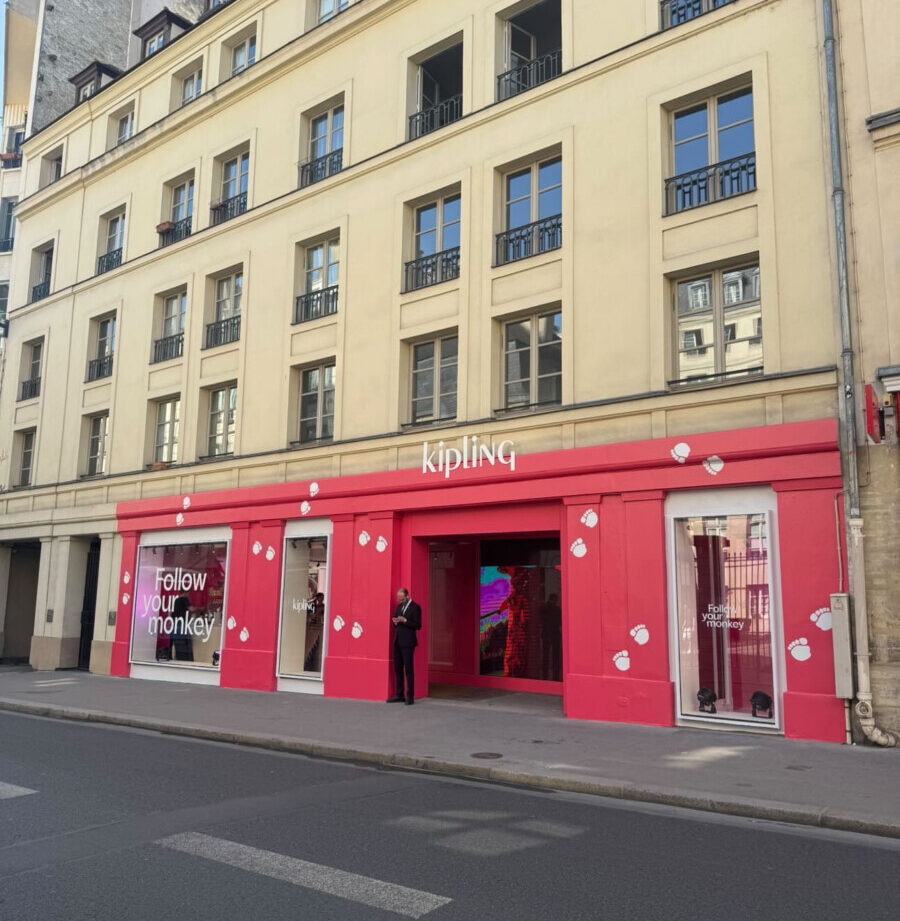
May 23 and 24, Kipling transformed the 18 Turenne Street, in the Marais, as a true brand statement.
Completely pink facade, oversized logo, monkey footprints on the walls, “Follow your monkey” displayed in the shop windows: for two days, the beige Haussmannian building almost disappeared behind the visual universe imagined by the brand.
At first glance, this might seem like simple event dressing. However, this type of activation tells a much deeper story about how brands today seek to exist in the public sphere.
The facade has become a medium in its own right
In a pop-up store strategy, the focus is often on the interior design, social media content, or influencer campaigns. However, one of the most powerful elements still remains the most visible: the facade.
The Activation of Kipling At 18 rue de Turenne is a very clear illustration of this. Even before entering the pop-up, the brand was already imposing its universe on the street thanks to a fully dressed facade, visible from the other side of the street and immediately identifiable in the Marais landscape.
This is precisely what makes façade cladding so strategic today: its ability to transform a physical space into a true medium.
The street becomes a space for visibility in its own right. The facade naturally attracts the eye, generating photos, spontaneous content, and a strong physical presence in an extremely busy neighborhood.
As part of a pop-up activation, this outdoor visibility represents considerable value. It allows the brand to exist well beyond the visitors of the pop-up itself and to reach a much wider audience, sometimes in a more organic and memorable way than a classic digital campaign.
Dressing a facade is also occupying a territory.
In a neighborhood like the Marais, this type of visual statement is never neutral.
Brands that activate a space here don't just rent square meters. They become part of a living environment, constantly observed and photographed. A neighborhood that watches as much as it inspires.
Choosing to dress an entire facade a few meters from the Place des Vosges is accepting this visibility and affirming a presence in public space.
For two days, Kipling didn't just occupy a place: the brand physically occupied a portion of the Parisian landscape.
And in a context where consumers are exposed to thousands of images every day, this ability to create a real, visible, and memorable presence remains extremely powerful.
When the outdoors perfectly extends the countryside
What makes this activation particularly successful is the consistency across all elements of the setup.
With Wild Buzz Agency, Kipling imagined an experience where the interior, exterior, and digital speak the exact same language.
Inside the pop-up, the Travel and Summer collections were showcased in an immersive setting designed to enhance the experience and encourage content creation. Outside, the storefront immediately echoed the campaign’s visual style, extending that immersive experience right out onto the street.
At the same time, FOOH content featuring giant bubbles was circulating on social media and in several European cities, while influencers were sharing updates about the event from the pop-up store.
The ensemble functioned as a coherent device where each element amplified the other.
The facade was therefore not just a decoration. It was an integral part of the campaign, creating a direct link between physical space, digital content, and brand visibility in the city.
This is also what allows some ephemeral activations to continue to live long after their closure.
Not all places allow this type of activation
Such visibility does not solely depend on a brand's creativity. It also depends enormously on the chosen location.
A large street-level display window, a visible and easily customizable facade, an identifiable address in a busy neighborhood: these are now essential characteristics for brands looking to create high-impact visual activations.
18 rue de Turenne brings together precisely these elements, and that’s also what makes it a space particularly suited for pop-up stores and event campaigns.
Today, the facade, storefront, and street visibility have become true strategic assets.
At Perfect Place Project, street visibility is one of the essential criteria.
When we select a space for the platform, we don't just look at its size or location.
We are also looking at its ability to exist from the outside: to be seen, recognized, photographed, identified before we even push the door open.
The Kipling pop-up at 18 rue de Turenne is a very clear illustration of this. A facade that naturally draws the eye, a space that amplifies the brand experience, and an activation that continues to circulate long after the location closes.
This is precisely what brands are looking for today when they envision ephemeral experiences in Paris.
And that is what we aim to offer through the referenced spaces on Perfect Place Project.
Looking for a space with high street visibility for your next activation? Discover the available spaces on Perfect Place Project.